
Building Self-Confidence Through Nurture and the EYFS
A child's early years are a crucial time for supporting them as they build self-confidence, resilience, and a sense of self. The EYFS (Early Years Foundation Stage) provides a comprehensive framework that guides early years practitioners in this vital work. This article is worth reading if you are a parent, carer, or practitioner looking to understand how nurseries and early years settings can nurture emotional and social growth, develop independence, and support positive reinforcement for the best possible start in life.
What makes the early years so important for child development?
The early years are a period of rapid child development, during which children acquire essential skills across the prime areas of learning: communication and language, physical development, and personal, social, and emotional development. During this time, children develop their personalities, habits, and attitudes towards learning and social interaction.
Young children benefit immensely from environments that nurture their growth and encourage them to make decisions. According to the statutory framework for the Early Years Foundation Stage, creating conditions that help children explore and feel secure promotes their well-being, self-worth, and confidence in their abilities.
How does the EYFS framework support children's confidence?
The EYFS framework is designed to support children's emotional, social, and academic development. It lays the foundation for future learning and enables early years providers to structure activities that develop self-confidence, resilience, and a positive attitude toward learning.
By focusing on effective practice, EYFS encourages early years practitioners to model behaviours that support self-esteem, promote emotional regulation in young children, and celebrate every small sense of accomplishment. These approaches are essential in helping children feel safe, supported, and open to learning.
What role do nurseries play in developing independence?
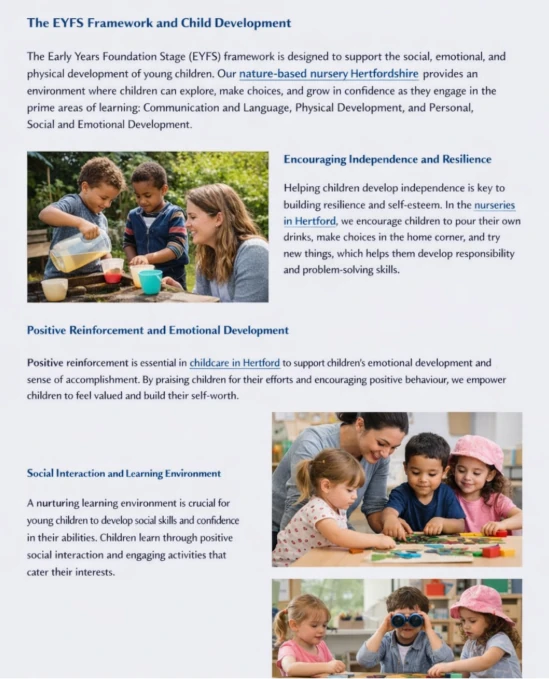
A nursery is not only a place for care but also a powerful environment for learning and growth. In the early years, developing independence is key to building strong problem-solving and decision-making skills. Children are given opportunities to pour their own drinks, select their own activities in the home corner, and navigate the areas of the classroom independently.
Such daily experiences help build their confidence and sense of agency. This willingness to try new things gives them the courage to face challenges, try unfamiliar tasks, and grow into self-assured learners.

How can practitioners use positive reinforcement effectively?
Positive reinforcement is a proven way to build a child's motivation, resilience, and self-worth. It involves offering children praise, recognition, and support when they exhibit desirable behaviours or efforts. This helps shape behaviour constructively and encourages repetition of those behaviours.
For example, acknowledging when a child helps a peer, completes a puzzle, or shows kindness, encourages the development of problem-solving skills, empathy, and self-discipline. As part of daily practice, it also fosters emotional development and supports children's journey toward academic achievement.
A learning environment that offers security, consistency, and support helps children to feel respected and loved. This, in turn, enhances confidence in the early years and provides the emotional foundation for deeper learning experiences.
Why is nurturing emotional development crucial in EYFS?
Children's emotional health in the early years is closely tied to how well they can manage challenges and form relationships. Social and emotional development is one of the prime areas of learning under the EYFS, and it's directly linked to children's overall well-being.
Such an environment is inclusive, celebrates diversity, and considers each child's interests. Through hands-on experiences, they develop a sense of belonging, purpose, and joy in learning.
What are some practical ways to help children try new things?
Children often need encouragement to try new things, especially when facing unfamiliar tasks or group activities. One effective method is modelling confidence and a positive mindset. When adults show enthusiasm and resilience, children are more likely to mirror those behaviours.
Another approach is giving children structured choices. Letting them make choices and decisions fosters autonomy and supports the development of responsibility. These strategies are especially valuable for children with higher anxiety or hesitation, helping them to progress at their own pace.
How does social interaction contribute to confidence in the early years?
Social interaction among groups of children promotes communication, empathy, and speech and language development. It also allows children to practise taking turns, negotiating, and forming friendships, which are all critical for early years success.
In structured settings such as nurseries, early years practitioners can facilitate enriching, inclusive play and conversations. These interactions help children learn not only how to express themselves but also how to listen and respond to others, key components of positive social behaviour.
Why are relationships with children vital in nursery settings?
Strong relationships with children create a sense of security, which is the foundation for all learning in the early years. When a child trusts the adult caring for them, they are more likely to participate, take risks, and express themselves.
A nursery setting that prioritises emotional connections over control helps children feel valued and heard. This trust-based approach also supports behavioural regulation and encourages the development of a positive attitude toward learning and other people.
What is the role of parents and carers in EYFS development?
Parents and carers are an integral part of a child's learning journey. The Early Years Foundation Stage emphasises the need for strong collaboration between families and early years providers. Sharing insights about a child's confidence, preferences, and behaviours enables a more tailored learning plan.
Practitioners who interact with children based on shared knowledge from families are more likely to provide relevant and meaningful support. This holistic approach to childcare ensures every child receives consistent messaging, encouragement, and care.